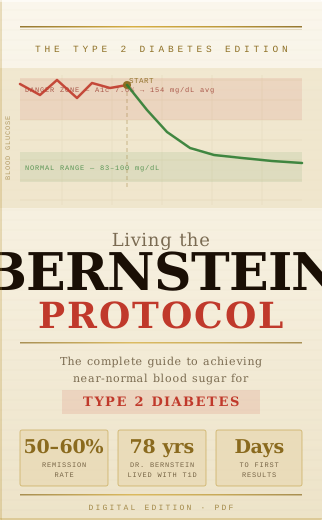
Living the Bernstein Protocol The proven low-carb system for Type 2 diabetes
The Type 2 Diabetes Edition

High blood sugar
doesn't hurt.
That's why it kills.

Dr. Richard Bernstein — endocrinologist, bestselling author of Dr. Bernstein's Diabetes Solution, and a 78-year diabetic who outlived every prognosis — discovered the one variable that controls blood sugar. This book applies his method to Type 2, in plain language.

The knowledge in this book is the difference between managing a slow decline and reclaiming a body that works — strong, medication-free, and still going strong at 80. Dr. Bernstein proved it.

"A1C 7.0 → 5.2 in 6 months. Zero medications." — Shrikant  ·  publicly shared at dLife.in
Get the Book — $47 → Instant PDF Download  ·  30-Day Money-Back Guarantee
Living the Bernstein Protocol — The Type 2 Diabetes Edition

The Damage Accumulates
in the Silence Between Symptoms

Most people with Type 2 feel "manageable." That is precisely the danger. High blood sugar does its worst work silently — on structures too small to feel, for years before the damage announces itself.

The kidneys, the eyes, the cognitive decline that gets blamed on age — same mechanism, same cause. None of it is inevitable. All of it is predictable.

The Renowned Doctor
Who Defined the Path.

Everything in this book traces back to one man: Dr. Richard K. Bernstein — endocrinologist, bestselling author of Dr. Bernstein's Diabetes Solution, and the physician who did more than anyone else in modern medicine to establish that near-normal blood sugar is achievable for people living with diabetes. His book has sold hundreds of thousands of copies worldwide and remains the most referenced clinical text on low-carbohydrate diabetes management.

Dr. Richard K. Bernstein — endocrinologist, author, Type 1 diabetic for 78 years
Dr. Richard K. Bernstein
1934 – 2025

Bernstein was diagnosed with Type 1 diabetes in 1946, at age twelve. The specialists of the era told him what to expect: nerve damage, kidney failure, a shortened life. He was expected to accept this.

He didn't — because he was an engineer before he was a patient. His instinct was not to manage a failing system, but to identify which variable was driving the failure. He tracked everything. The pattern was unmistakable: large carbohydrate loads caused large blood sugar swings. Large swings caused damage. The fix, once visible, was not complicated: remove the large input.

He cut carbohydrates severely. His blood sugars stabilized. The complications that had been progressing slowed and stopped. He was so convinced by his own data that he went to medical school in his forties — because he understood something the clinical mainstream hadn't yet accepted, and he wanted the credentials to say it publicly.

He passed away peacefully in April 2025 at age 90, having lived with Type 1 diabetes for 78 years. He outlived everyone who had quietly written him off. He was not a medical anomaly. He was a man who found a logical, reproducible system and applied it without compromise for seven decades. Dr. Bernstein's Diabetes Solution is the distillation of that system.

"The complications of diabetes are not inevitable. They are the consequences of chronically elevated blood sugar — and chronically elevated blood sugar is not inevitable either."
— Dr. Richard K. Bernstein, Dr. Bernstein's Diabetes Solution

Here is the part most discussions about Bernstein miss: his protocol applies more powerfully to Type 2 than it ever did to his own Type 1 condition. His beta cells were gone entirely. Yours are not. The damage in Type 2 is functional — not structural. Functional damage can be reversed. The window he never had is the window you are looking at right now.

50–60% Remission rate at one year in structured low-carb trials — A1c below 6.5% without glucose-lowering medication. Documented, not promised.
Days How quickly many T2D readers see first meaningful blood sugar improvements after starting strict carb reduction. Not weeks. Days. Chapter 6 explains why.

Real Outcomes from
Real People Who Did This.

These are publicly shared accounts from individuals who followed a strict low-carbohydrate protocol for Type 2 diabetes — the same approach this book is built on. They are not cherry-picked outliers. They represent a documented, repeatable pattern.

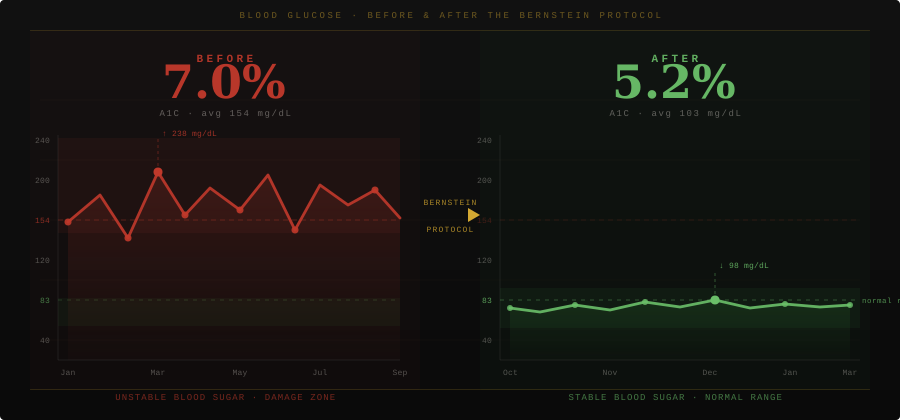
Blood glucose before and after the Bernstein Protocol — A1C from 7.0% to 5.2%
Before
7.0%
A1C · avg 154 mg/dL
After
5.2%
A1C · avg 103 mg/dL
6 months on the Bernstein Protocol

5.2% is non-diabetic range. This person left Type 2 diabetes behind in six months — without medication. The pattern repeats across every publicly documented case below.

74 → 42HbA1c (mmol/mol)
4 monthsTime to result

"After 4 months my HbA1c is down from 74 to 42 mmol/mol."

Chris Hogger  ·  Source: LowCarbProgram.com
7.0 → 5.2A1C (%)
6 monthsTime to result
ZeroMedications

"A1C went from 7.0 to 5.2 in six months. I am on no medicines."

Shrikant  ·  Source: dLife.in
42+ lbsWeight lost
1 yearTime to result

"I am not diabetic. Blood pressure is super. My cholesterol is down."

Charles McMonagle, 70  ·  Source: Freshwell Low Carb Project
5.6Final A1C (%)
20 yearsDisease duration

"My A1C is down to 5.6. My Type 2 diabetes is in remission — after twenty years."

Dean  ·  Source: DiabetesMealPlans.com

These accounts are publicly available and attributed. Individual results vary. Not everyone achieves remission — but the direction of change, for people who commit seriously to strict carb reduction, is consistently toward better numbers and reduced medication dependence.

An A1c of 7.0%
Is Not "Well-Controlled."
It Is a Damage Threshold.

154

An A1c of 7.0% represents an average blood glucose of 154 mg/dL. A healthy non-diabetic person runs between 83 and 100 mg/dL. The 50+ point gap between those numbers is where the complications live.

The clinical threshold of 7.0% was not established because it prevents complications. It was established because it was achievable with standard medications and diet advice. It is a benchmark of pharmaceutical management — not a benchmark of health.

Dr. Bernstein was one of the first clinicians to make this argument publicly, and bluntly. In his book — the most comprehensive diabetes management guide written by a physician who has actually lived with the disease for 78 years — he defines the target clearly: near-normal blood sugar. Not "controlled." Not "acceptable." Near-normal. The same range a non-diabetic person runs.

That is not an aggressive or unusual position. It is the only position that makes physiological sense if the goal is to prevent the complications listed above. The question the book answers is how to get there — and why the Bernstein method makes it more achievable for a Type 2 patient than for almost any other.

Your Pancreas Is Still Working.
That Means the Door Is Open.

Type 2 diabetes is progressive — but the direction of progression is not fixed. The beta cells that produce your insulin are not gone. They are exhausted and overwhelmed by years of being asked to produce more and more insulin against a backdrop of deepening resistance.

That distinction is everything. An overwhelmed system that gets relief can recover function. Remove the overload, and the demand drops to a level your pancreas can comfortably handle again. This is the mechanism behind every remission case in the testimonials above — and the reason the same protocol works more powerfully for Type 2 than it ever did for Bernstein himself.

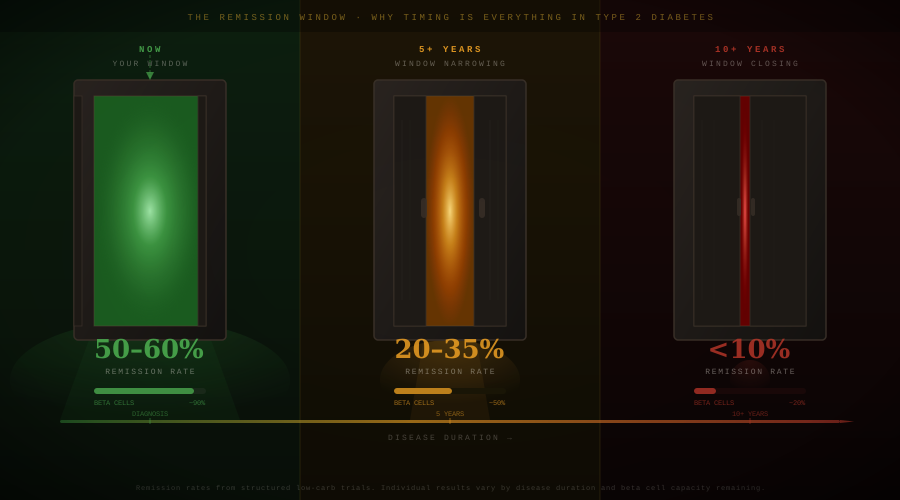
The Remission Window — beta cell function and remission rates over disease duration
Your situation — right now

Beta cells are still present and functional. The problem is carbohydrate overload creating a demand your system cannot sustainably meet. Remove that overload dramatically and the demand drops to a level your pancreas can handle. Recovery of function — and in many cases, remission — is documented and real.

After years of continued overload

Beta cells do not have unlimited resilience. Years of hyperglycemia and hyperinsulinemia cause progressive beta cell exhaustion and loss. The window for remission narrows. The gap between "management" and "reversal" widens. A condition that was reversible becomes one that must simply be managed — and managed harder.

The point isn't to alarm you. It's to name something most medical conversations about T2D leave out: this disease has a time dimension, and that dimension is currently working in your favor. The beta cells you have today are the most you'll ever have again. The longer the overload continues, the harder reversal becomes — but right now, while you're reading this, the conditions for a different outcome are still in place.

If you are reading this page, your window is still open. The 50–60% remission rates you saw earlier come from people in exactly this position — and the chapters ahead are how you join them.

12 Chapters Written
Specifically for the T2D Reader

This is not a general wellness book adapted for diabetes. Every chapter was written for someone managing Type 2 — including two chapters that exist only in this edition (medication interactions and the reversal question every T2D reader is privately asking), plus a new appendix on the newer injectable blood sugar medications that have reshaped T2D treatment.

INTROWhy the Advice You Followed Let You Down — you were not failing the system; the system was failing you
CH. 1The Doctor Who Showed Another Way — Bernstein's 78-year proof that near-normal blood sugar is achievable
CH. 2The Energy Block — insulin resistance, hyperinsulinemia, and why your body got stuck in storage mode
CH. 3The Moderation Trap — why "eat less, move more" almost always fails for T2D specifically
CH. 4What Happens to Your Medications New chapter — blood sugars can drop fast enough in week one that your current dose may need adjusting. What to tell your doctor before that happens.
CH. 5The Law of Small Numbers — the math that makes everything more predictable and forgiving
CH. 6The 6-12-12 Plan — a dead-simple daily carb framework and why T2D numbers often drop within days
CH. 7The Reversal Question New chapter — what remission actually means, realistic timelines, and honest expectations
CH. 8Building Your Plate — real meals, real macros, zero guesswork
CH. 9Breaking the Sugar Craving Cycle — why the cravings are biological, not moral, and how to end them
CH. 10If Your Doctor Mentions Insulin — what it means, what changes, and why it isn't failure
CH. 11Strength for the Journey — why resistance training is as close to a drug as exercise gets for T2D
CH. 12The Legacy — patterns from the T2D community, and the trajectory that doesn't have to be yours
APP. AFridge Summary — medication reminders, 3-month milestones, and daily blueprint in one printable page
APP. BThe New Injectables & The Protocol New chapter — what these medications actually do, why the diet still matters when the numbers look fine on them, and the medication adjustments to expect when you combine the two.
Pedro Ribeiro
Pedro Ribeiro
T1D for 14 Years · Father of Four · Bernstein Protocol Practitioner

Diagnosed with Type 1 diabetes in 2011, Pedro spent 14 years applying Dr. Bernstein's low-carbohydrate principles to his own management.

He is not a doctor. He is not selling supplements. He is someone who has watched what actually happens when people with T2D commit to this approach seriously — and who wanted to write the clear, honest guide he wishes had existed for them from the start.

Don't Buy This Book If…

This is a genuine filter, not marketing copy. If any of the following describes you, this book will likely disappoint — and I'd rather you not buy it than buy it and feel misled.

✕You're looking for a moderate adjustment — cutting back a little, swapping white bread for wholegrain — and expect meaningfully different results. Moderate carb reduction keeps the insulin cycle running. This book explains why, and doesn't offer a softer version of the approach.
✕You're not willing to have a proactive conversation with your doctor about adjusting your medications. Blood sugars can improve fast enough that your current dose becomes too high — this is a safety issue, not a preference, and the book addresses it seriously.
✕You want someone to confirm that the standard advice will work if you just try harder. That story has already played out for most T2D readers. This book does not tell a more optimistic version of it — it tells a different story entirely.

This IS For You If…

Start This Week.
The Window Is Open.

Living the Bernstein Protocol — read on any device, instant PDF download
Complete Digital Edition — Type 2 Diabetes
Living the Bernstein Protocol

Most people with Type 2 diabetes will follow the standard path — medications that increase over time, complications that accumulate quietly, a body that slowly stops doing what it should. This book is the manual for the path that most never find. The knowledge here has freed people from that trajectory. It can free you from it too.

  • →The complete 12-chapter T2D guide — every chapter written specifically for the Type 2 reader, including two that exist only in this edition and nowhere else
  • →Chapter 4 — What Happens to Your Medications — the safety chapter most people never get. Blood sugars can drop fast enough in week one that your current dose may become too high. What to tell your doctor before that happens
  • →Chapter 7 — The Reversal Question — what remission actually means, realistic timelines by stage, and honest expectations so you can make an informed decision rather than a hopeful one
  • →Appendix B — The New Injectables & The Protocol — what GLP-1 medications actually do and don't do, why the diet still matters when your numbers look fine on them, and the critical questions to bring to your next appointment.
  • →The Fridge Summary — a printable one-page daily blueprint with medication reminders and 3-month milestones. Many readers tape it to their kitchen cupboard on day one
  • →Instant PDF download — read on any device, fully printable, yours to keep permanently
$47

Less than one month of glucose testing strips. Less than one co-pay. A small fraction of what a single complication will cost you — in money, in health, in years.

Get Instant Access — $47 →
30-Day Money-Back Guarantee

Read it. If it's another version of advice you've already tried — or it's simply not right for your situation — ask for your money back within 30 days, no questions asked. I'd rather have readers who act on this than buyers who feel informed and continue as before.

Before You Decide

Is this safe if I'm currently taking diabetes medications?

This is the most important question to ask, and Chapter 4 addresses it in full. When blood sugar improves on a low-carbohydrate diet, it can happen fast — sometimes within days. If you're on oral diabetes medications or insulin, your current dose may become too high as your blood sugar drops. The book explains exactly what to tell your doctor before you start, what to watch for, and what adjustments are commonly needed. Do not make medication changes on your own — but do read Chapter 4 before your next appointment.

I'm on one of the newer injectable blood sugar medications. Does this still apply to me?

Yes — and in some ways it applies more urgently, not less. These medications lower blood sugar effectively on their own, which means a low-carbohydrate diet layered on top can drop your numbers fast enough that your current dose becomes too high. That's a medication-adjustment conversation, not a lifestyle preference. Appendix B is the dedicated chapter on this: what the medication actually does (and doesn't) do, why the diet still matters when the numbers look "fine" on it, what typically changes if you eventually come off it, and the specific questions worth bringing to your next appointment. Read Appendix B before making any changes on your own.

I've had Type 2 diabetes for over 10 years. Is it too late for this to help?

It depends on how much beta cell function remains. The longer T2D goes unaddressed, the more beta cell capacity is lost — and complete remission becomes less likely as that happens. Chapter 7 covers this honestly, with realistic timelines by stage. That said, "remission" is not the only outcome worth pursuing. Many long-term T2D readers see meaningful reductions in A1C, medication requirements, and complication risk even when full reversal isn't achievable. The book is clear about what to expect at different stages, so you can make an informed decision rather than a hopeful one.

How is this different from just "going low-carb"?

Most low-carb advice is written for weight loss in a general population. The Bernstein approach is built around a specific physiological principle — the Law of Small Numbers — which holds that small carbohydrate inputs produce small, predictable blood glucose rises, which require small correctable insulin responses. That matters more for T2D than for anyone else, because an insulin-resistant system amplifies every glucose spike. "Moderate" low-carb (100–150g/day) keeps the insulin cycle running. This book explains why the threshold that makes a difference for T2D is lower than most general low-carb programs suggest — and what happens, biologically, at that threshold.

What if I try it and it doesn't work for me?

There's a 30-day money-back guarantee. If you read the book and it's another version of advice you've already tried — or it's simply not right for your situation — reply to your purchase confirmation email and I'll refund the full $47, no questions asked, within 24 hours. There's no return form. The risk of trying is $47. The risk of not trying is what Chapter 1 is about.

Will my doctor support this approach?

Some will. Many won't — at least not immediately. The Bernstein Protocol sits outside mainstream dietary guidelines, which still recommend moderate carbohydrate intake for diabetics. That said, the evidence base for low-carbohydrate approaches in T2D has grown substantially in recent years, and an increasing number of endocrinologists and GPs work with patients who use it. The book is not asking you to go behind your doctor's back. It's asking you to bring specific, informed questions to your next appointment — particularly around medication adjustment — and to make decisions collaboratively. Chapter 4 is written specifically for that conversation.

Every Day You Wait,
the Window Gets Smaller.

The damage accumulates quietly. The beta cells exhaust slowly. The complications arrive not suddenly, but as the inevitable result of years of elevated blood sugar that someone called "well-controlled." You have the information now. The question is whether you act on it.

You don't have to be perfect. You just have to start — and start with a map that actually leads somewhere.

Get the Book — $47 →